
Analysis
M23 Has Reached the Ground. So Has the Great Lakes Power Struggle.
By Alain Nzeyimana ·
M23 Has Reached the Ground. So Has the Great Lakes Power Struggle.
M23 Has Reached the Ground.
Get our raw articles before they are published anywhere else. Join the official Verifyr Telegram Channel t.me/VerifyrOfficiaSo Has the Great Lakes Power Struggle.
A ceasefire-monitoring mission has finally deployed in eastern Congo. But the test ahead is much larger than M23.
Peace has finally reached the ground in eastern Congo.
Or, at least, the people responsible for monitoring it have.
On Monday, a mission began observing the implementation of a ceasefire between Congolese forces and the Rwanda-backed AFC/M23 rebellion. It is the first field deployment under a monitoring mechanism established through the Qatar-mediated peace process.
That is an important development.
But it should not be mistaken for peace.
The monitors have arrived in a conflict zone where previous ceasefires have collapsed, armed groups have repeatedly adapted to diplomatic pressure, and the political geography extends far beyond the front lines of North and South Kivu.
Because the conflict is not simply between Kinshasa and M23.
It sits inside a far larger struggle involving Rwanda's security concerns, Congo's sovereignty, Burundi's increasingly difficult relationship with Kigali, armed groups operating across borders, the credibility of the East African Community, and now the strategic interests of the United States.
The question is therefore not simply whether the monitors can record ceasefire violations.
The bigger question is whether a ceasefire can survive when the political conflicts surrounding it remain unresolved.
The first monitors, the latest agreement
The deployment is a milestone because peace agreements are often strongest on the day they are signed and weakest when they reach the ground.
Congo and M23 agreed in Doha last year to create a mechanism to monitor an eventual permanent ceasefire. But persistent fighting continued even as negotiators developed the political architecture. The new field deployment is therefore the moment when diplomacy moves from conference rooms into one of Africa's most dangerous theatres of conflict.
That transition matters.
A document can establish a ceasefire.
Only events on the ground can prove that it exists.
And the monitors face a conflict in which the international community has already spent years demanding the same basic commitments: the end of offensive operations, respect for Congolese sovereignty and an end to external support for armed groups.
The United Nations has repeatedly described M23 as backed by Rwanda and has demanded an end to such support. Kigali has consistently denied supporting the rebellion and argues that its own security concerns, particularly the presence of the FDLR and other hostile forces in eastern Congo, must also be addressed.
That disagreement is not a footnote.
It is one of the reasons the conflict has proved so difficult to end.
M23 is the immediate actor. Rwanda is the regional question.
Any serious analysis of eastern Congo eventually reaches the same conclusion:
M23 may be the armed actor on the ground, but Rwanda remains central to the regional calculation.
This is not simply because of international allegations regarding support for the rebellion.
It is because Rwanda's entire security doctrine in the Great Lakes is shaped by the consequences of the 1994 genocide, the presence and history of hostile armed groups in the wider region, and Kigali's conviction that threats ignored in eastern Congo can eventually reach Rwanda itself.
But Congo sees the equation differently.
For Kinshasa, the presence of foreign-backed armed actors is not a theoretical security concern. It is a direct challenge to territorial sovereignty.
That creates a fundamental contradiction.
Rwanda argues that its security concerns must be taken seriously.
Congo argues that those concerns cannot justify foreign interference or the presence of a Rwanda-backed armed movement on Congolese territory.
Both narratives can explain the political logic of the conflict.
Neither is sufficient to create peace on its own.
And that is the strategic problem facing President Paul Kagame.
A lasting settlement could require Rwanda to accept a regional security framework in which its legitimate security concerns are addressed without armed groups becoming instruments of cross-border influence.
That is far more difficult than signing a ceasefire.
Trump has entered the Great Lakes equation
The arrival of the United States changes the scale of the peace process.
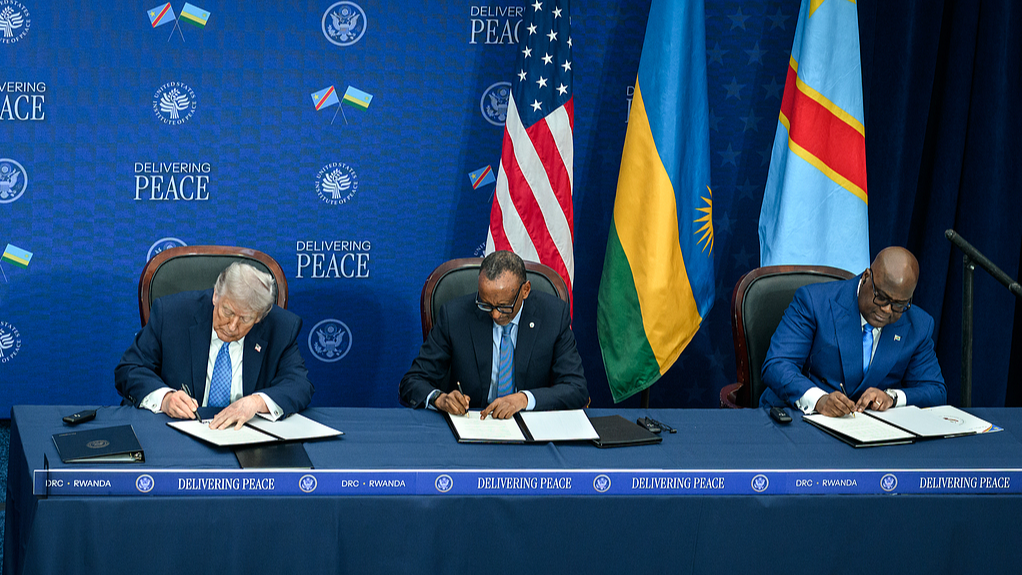
Washington's involvement has placed President Donald Trump directly into an attempt to resolve one of Africa's most intractable conflicts. Reuters previously reported that Washington pushed for peace efforts that could also help unlock major mining and investment opportunities in the region.
This is where geopolitics becomes particularly interesting.
For Trump, peace in the Great Lakes is not only a humanitarian or diplomatic objective. The region contains minerals critical to the global competition for technology, energy transition and advanced manufacturing.
A stable eastern Congo is therefore strategically valuable.
But American pressure can only go so far.
Washington can bring parties to agreements.
It cannot eliminate decades of regional mistrust with a ceremony.
Trump's real challenge is that the conflict has multiple negotiating tables.
There is Congo versus M23.
There is Congo versus Rwanda.
There are discussions over armed groups.
There are questions of regional security.
There are competing economic interests.
And there are domestic political realities in every capital.
A Washington agreement can address one relationship.
A Doha process can address another.
But peace will remain fragile if those agreements do not eventually become part of one coherent regional security architecture.
Enter Ndayishimiye and the Burundi front
This is where the story becomes bigger than Rwanda and Congo.
President Évariste Ndayishimiye's Burundi is geographically and strategically tied to the conflict in eastern Congo.
Burundi shares a long border with the DRC. The instability around South Kivu can rapidly affect Burundi's security, refugee flows and economic interests. The conflict has also drawn Burundi into the wider regional security equation.
But Burundi and Rwanda—two members of the East African Community—have their own unresolved tensions.
Bujumbura has repeatedly accused Kigali of supporting Burundian armed opposition groups and dissidents hostile to the Ndayishimiye government. Rwanda has denied those accusations.
The dispute mirrors the wider Great Lakes problem.
Every government sees armed opponents across the border through the language of national security.
One country says it is protecting itself.
The other says its sovereignty is being violated.
This does not mean the Burundi-Rwanda dispute and the M23 conflict are identical.
They are not.
But they are connected by the same regional weakness:
the absence of a trusted and enforceable system capable of preventing states from accusing each other of using armed groups as instruments of influence.
And the allegations involving Burundian dissidents matter because they make it difficult to discuss peace in eastern Congo as though it exists in a separate geopolitical universe.
Burundi's relationship with Rwanda is part of the Great Lakes security environment.
So is Rwanda's relationship with Congo.
So are the armed groups operating between and within the region's borders.
A ceasefire in eastern Congo cannot automatically produce regional peace if the wider proxy logic survives.
Kagame and the proxy problem
The central question is not whether every armed group in the region is directly controlled by a neighbouring government.
That would be an oversimplification.
The Great Lakes is full of local grievances, historical trauma, ethnic tensions, political movements, criminal economies and armed organisations with their own agendas.
But regional governments also understand the strategic value of armed actors.
That is why accusations of cross-border support are so politically explosive.
Rwanda accuses the DRC of failing to neutralise forces it considers hostile.
Congo accuses Rwanda of backing M23.
Burundi has accused Rwanda of supporting armed opposition against Bujumbura.
Rwanda denies the accusations made by Burundi and rejects allegations that it supports M23.
The result is a regional security system built on mutual suspicion and competing evidence.
And this is precisely where ceasefire monitoring can become more important than merely recording who fired first.
The Great Lakes needs verification mechanisms that are credible enough to challenge every side.
Not only M23.
Not only the DRC.
Not only Rwanda.
Every armed group and every allegation of state support should be subject to transparent verification.
Without that, each side will continue entering negotiations with its own intelligence, its own accusations and its own version of reality.
The East African Community's credibility problem
The conflict has also exposed an uncomfortable truth about the East African Community.
The EAC is meant to represent deeper regional integration.
Yet some of its most important members have been unable to resolve fundamental security disputes between themselves.
Congo, Rwanda and Burundi all belong to the same regional organisation.
They share economic interests.
They participate in regional institutions.
They are connected by trade routes, borders and populations.
But when the conflict became serious enough, the region repeatedly looked outside itself for solutions.
The United States.
Qatar.
The African Union.
The United Nations.
Outside actors are not the problem. International diplomacy has been essential.
But the question remains:
What does regional integration mean if the region cannot build a trusted security mechanism for its own members?
The East African Community cannot become only an economic club that functions when borders are peaceful and disappears when its members accuse each other of supporting armed groups.
Security must become part of integration.
Otherwise, political integration will remain weaker than the conflicts it claims to transcend.
Peace on paper has reached the ground. Can it survive there?
The arrival of ceasefire monitors is a genuine moment of progress.
It creates eyes on the ground.
It creates a mechanism for reporting violations.
It may help prevent minor incidents from becoming major escalations.
And it could build the confidence required for further political agreements.
But monitors cannot solve the underlying strategic problem alone.
They can tell the world what happened.
They cannot by themselves make states agree on why it keeps happening.
That requires a deeper political settlement.
The Congo conflict will not be permanently resolved if M23 is treated as the entire problem.
Nor will it be resolved by discussing Rwanda's security concerns while ignoring Congo's sovereignty.
Nor can regional peace be complete while Burundi and Rwanda continue to live with accusations involving armed opposition and cross-border insecurity.
The region needs to stop negotiating its conflicts one armed group at a time.
The Great Lakes needs a regional security reset
The practical solution is not another summit followed by another vague declaration.
The region needs a stronger and more integrated security architecture built around several principles.
1. One regional verification system
Allegations of cross-border support for armed groups should be investigated through a credible, independent mechanism with access to relevant border areas and clear public reporting.
The principle must apply to everyone.
2. Armed groups must be treated as a regional security problem
M23, the FDLR and other armed groups should not be discussed selectively according to which capital is making the complaint.
A regional mechanism should identify threats according to evidence.
3. Rwanda's security concerns and Congo's sovereignty must be addressed simultaneously
The region cannot demand that Congo accept violations of its sovereignty.
But it also cannot build a durable peace while leaving genuine cross-border security concerns unresolved.
Both issues must be addressed together.
4. Burundi-Rwanda relations need a separate security channel
The allegations involving Burundian armed dissidents should not be left to public accusations and diplomatic hostility.
A permanent verification and dialogue mechanism could reduce the risk that political suspicion eventually becomes military confrontation.
5. The EAC must move from observer to security guarantor
The region cannot continue depending entirely on Washington, Doha or the United Nations whenever a crisis escalates.
External mediation should support African and regional institutions—not permanently replace them.
The bigger test
The ceasefire monitors have arrived in eastern Congo.
That is progress.
But the real test begins now.
Can the ceasefire survive?
Can M23 and the Congolese state avoid a return to major confrontation?
Can Rwanda's security concerns be addressed without undermining Congolese sovereignty?
Can Burundi and Rwanda manage their own tensions without creating another front in the regional struggle?
And can the East African Community prove that integration means something when security becomes difficult?
Trump, Kagame, Ndayishimiye, Tshisekedi, Qatar, the African Union and the United Nations are all now part of different parts of the peace equation.
That should be an advantage.
But it could also create a fragmented process where every agreement solves one problem while leaving three others untouched.
The Congo war is no longer simply about M23.
It is about whether the Great Lakes can escape a regional system in which armed groups, national security fears, unresolved historical trauma and competing geopolitical interests continually cross borders faster than peace agreements can contain them.
The monitors can record the ceasefire.
But only a new regional security architecture can give it a chance to survive.
By Alain Nzeyimana Founder & CEO | Verifyr
Related intelligence
Ethiopia: A Conflict That Could Reopen the Horn of Africa
Ethiopia: A Conflict That Could Reopen the Horn of Africa
5 Oct 2026
America’s Jobs Market Is Losing Momentum — What Happens Next?
America’s Jobs Market Is Losing Momentum — What Happens Next?
5 Oct 2026
Trump, the Midterms and the Long Wait to 2028
Trump, the Midterms and the Long Wait to 2028
23 Aug 2026
Plans
Free
$0
Instant verdicts, no signup
Pro
$49
Full reports + certificates
Growth
$149
1,000 audits + team access
Newsroom report
$199
One analyst-reviewed certificate
Newsletter
Get verified stories in your inbox
One email when a new audit drops. No spam.