
Geopolitics
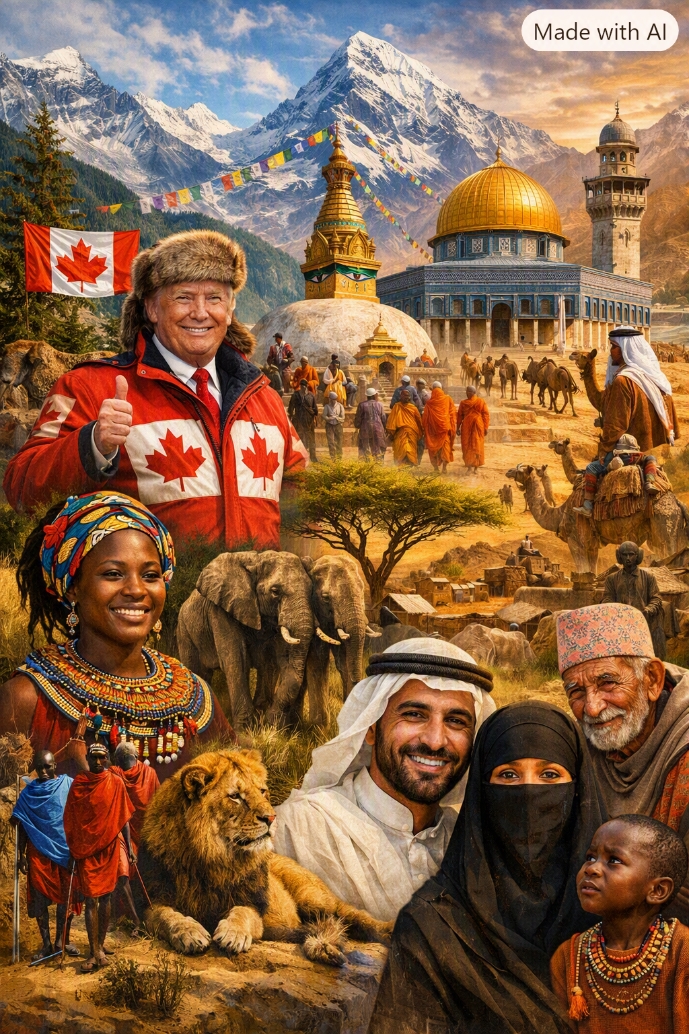
From Canada to Nepal: The New Geopolitical Map Has No Borders
By Alain Nzeyimana ·
From Canada to Nepal: The New Geopolitical Map Has No Borders
From Canada to Nepal: The New Geopolitical Map Has No Borders
Get our raw articles before they are published anywhere else. Join the official Verifyr Telegram Channel t.me/VerifyrOfficiaThe headlines look unrelated.
Canada is fighting a tariff war with the United States. The CIA director has travelled to Moscow. Iran and the Strait of Hormuz remain at the centre of a global energy crisis. China and Russia are watching every American move. Nepal is battling AI-generated misinformation after deadly floods. Meta has suddenly become part of a national crisis-management problem.
Different countries. Different crises.
But they are increasingly part of the same geopolitical story:
The world is no longer divided neatly between economics, security, technology and domestic politics. Pressure in one arena now travels rapidly into another.
Canada: When economic pressure reaches America's closest ally
The Canada–U.S. tariff conflict is particularly revealing.
Washington and Ottawa briefly appeared to pull back from a major escalation, with steep tariffs paused before talks subsequently deteriorated again. New U.S. tariffs were imposed on roughly $20 billion in Canadian goods after negotiations collapsed, and Prime Minister Mark Carney responded with a commitment to retaliate dollar for dollar.
This is no longer simply a disagreement over trade.
Canada is one of America's closest allies. It is tied to the United States through geography, NATO, intelligence and some of the deepest commercial integration in the world.
Yet economic pressure has pushed even this relationship into open confrontation.
That matters because trade policy is now part of the geopolitical arsenal.
Moscow: The CIA becomes the messenger
Then there is Russia.
CIA Director John Ratcliffe's trip to Moscow has brought the language of intelligence directly into the geopolitical picture. Reuters reported that Ratcliffe travelled to Moscow for meetings with Russian officials, while subsequent reporting indicated that concerns over possible Russian operations against NATO and Iran were among the issues raised.
Trump publicly downplayed the idea that Russia would attack NATO.
Yet the need to send America's CIA director to Moscow suggests that direct communication remains necessary at a moment when deterrence, intelligence and diplomacy are operating simultaneously.
This is the new reality of great-power competition.
You can threaten. You can sanction. You can arm allies. And at the same time, you still need a private channel to your adversary.
Hormuz: A regional crisis with a global bill
The Strait of Hormuz demonstrates why geography no longer contains crises.
The dispute involves Iran and the Middle East, but the consequences extend far beyond the region. Shipping, energy prices and global trade are all exposed. Reports have described U.S. pressure over reopening the waterway alongside Iranian efforts to use transit access as leverage.
China cannot ignore this.
Russia cannot ignore this.
Europe cannot ignore this.
Africa cannot ignore this.
A crisis in one narrow stretch of water can ultimately reach consumers through fuel prices, inflation and supply chains.
That is why Hormuz is not only a Middle Eastern issue. It is global infrastructure under geopolitical pressure.
China: Watching the United States under pressure
China does not need to be directly involved in every crisis to benefit from understanding it.
Beijing is watching how Washington manages:
Russia and Ukraine
Iran and Hormuz
NATO's internal credibility
trade pressure against allies such as Canada
the global race for AI infrastructure
China is learning about American limits, European dependence and the consequences of economic coercion.
The most important geopolitical moves are not always made by the country making the loudest noise.
Sometimes power is watching the others spend theirs.
Nepal and Meta: The information crisis becomes a state crisis
Nepal may seem like the smallest story in this global picture.
It may actually be one of the most revealing.
After devastating floods, Nepal's government asked Meta and TikTok to act against AI-generated videos, misleading content, graphic material and fraudulent donation schemes circulating online. Independent fact-checking has also found fabricated or misrepresented flood content spreading after the disaster.
Look at what that means.
A government responding to a national disaster is now dependent, at least partly, on private technology platforms to help restore information integrity.
This is a profound geopolitical shift.
Meta is not a state. But its infrastructure can influence whether a state's population sees accurate information during a crisis.
Technology companies are increasingly becoming part of the architecture of national security.
And AI is accelerating the problem.
Africa: The next front is infrastructure
Africa sits at the intersection of all these pressures.
The continent is being drawn into the competition over:
critical minerals
energy
trade routes
AI
data centres
information
geopolitical alliances
Africa's data-centre capacity is still small by global standards, but demand is accelerating. The World Economic Forum cites estimates that African demand could rise from around 0.4 GW today to between 1.5 and 2.2 GW by 2030, while the African Data Centres Association says the continent currently accounts for only around 0.6% of global data-centre capacity.
That makes electricity and computing capacity strategic questions.
In the AI era, a country without sufficient energy and digital infrastructure risks becoming dependent on countries that have both.
Africa therefore cannot treat AI as merely a technology trend.
It is an infrastructure, energy and sovereignty issue.
The old compartments have disappeared
This is the central lesson from Canada, Moscow, Hormuz and Nepal.
A tariff can become a national-security issue.
An intelligence trip can become a diplomatic message.
A maritime route can become an inflation problem.
A social-media platform can become part of emergency response.
An AI-generated video can become a national-security concern.
And a data centre can become a question of energy sovereignty.
The old geopolitical map separated these worlds. The new one does not.
The Verifyr conclusion: resilience is now national power
The most successful countries will not simply be those with the largest militaries or economies.
They will be those capable of building resilience across trade, energy, information, technology and security at the same time.
That means:
Canada needs greater economic diversification alongside alliance management.
NATO needs credible deterrence and reliable communication channels with Moscow.
The world needs alternatives and resilience around critical chokepoints such as Hormuz.
Governments need stronger systems for responding to AI-generated misinformation.
Africa must treat energy and data infrastructure as part of strategic sovereignty.
The next great geopolitical crisis may not arrive as a war, a tariff or a cyberattack.
It may arrive as all three at once, amplified by artificial intelligence and transmitted globally in real time.
That is why the new geopolitical map has no borders.
By Alain Nzeyimana Founder & CEO | Verifyr
Related intelligence
Kimberly Guilfoyle: When Diplomacy Meets Geopolitical Rivalry
Kimberly Guilfoyle: When Diplomacy Meets Geopolitical Rivalry
13 Oct 2026
Brazil: The Global Power That Refuses to Choose a Side
Brazil: The Global Power That Refuses to Choose a Side
5 Oct 2026
Greenland, Russia, Britain and the Red Sea Signal a New Geopolitical Era
Greenland, Russia, Britain and the Red Sea Signal a New Geopolitical Era
18 Sept 2026
Plans
Free
$0
Instant verdicts, no signup
Pro
$49
Full reports + certificates
Growth
$149
1,000 audits + team access
Newsroom report
$199
One analyst-reviewed certificate
Newsletter
Get verified stories in your inbox
One email when a new audit drops. No spam.