
Geopolitics
Greenland, Russia, Britain and the Red Sea Signal a New Geopolitical Era
By Alain Nzeyimana ·
Greenland, Russia, Britain and the Red Sea Signal a New Geopolitical Era
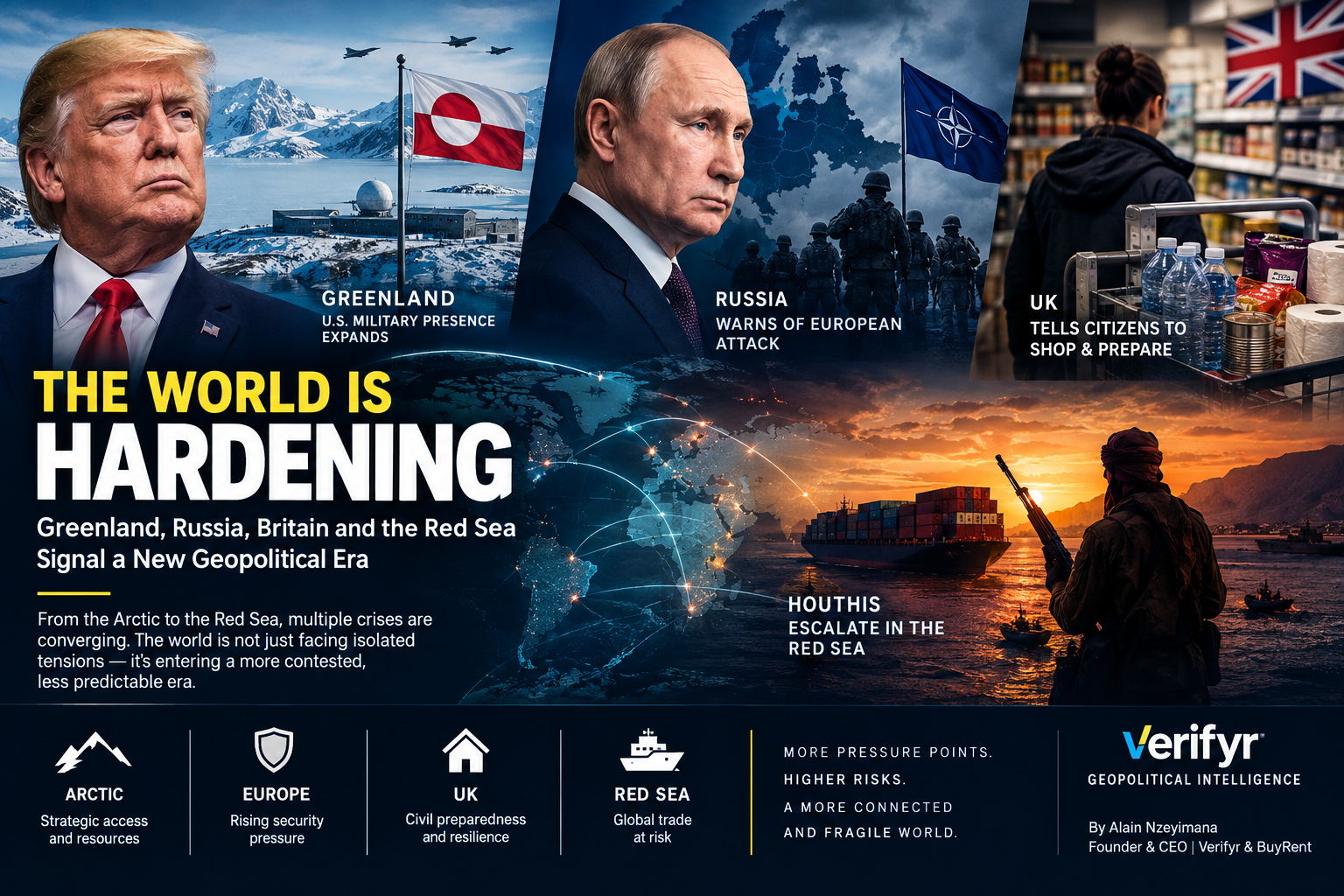
The World Is Hardening: Greenland, Russia, Britain and the Red Sea Signal a New Geopolitical Era
Get our raw articles before they are published anywhere else. Join the official Verifyr Telegram Channel t.me/VerifyrOfficiaVerifyr Geopolitical Intelligence | September 18, 2026
The most important geopolitical story of the day may not be any single battlefield.
It is the increasingly obvious convergence of several pressure points — the Arctic, Europe, Russia, the Middle East and global trade — into one much more unstable strategic environment.
On Friday, President Donald Trump said the United States would begin developing a “large Military presence” in Greenland, following his announcement of an agreement with Denmark and Greenland that he said would give Washington permanent control over security-related matters on the island.
Reuters had reported earlier that Washington and Copenhagen were moving toward an agreement that would expand the American military presence in Greenland, potentially including arrangements connected to the proposed Golden Dome missile-defence system and restrictions on Chinese influence. Trump’s announcement went further, however, describing permanent American security authority. Denmark and Greenland had not publicly commented on the claim at the time of reporting.
That matters far beyond Greenland.
The Arctic is becoming a military theatre
Greenland sits between North America and Europe and is strategically positioned across the Arctic approaches.
The United States already operates militarily in Greenland, including at Pituffik Space Base, but the latest developments point toward a potentially much broader American footprint.
The timing is significant.
The US and its NATO partners are already increasing Arctic activity. Operation Arctic Vanguard has involved American F-16s and other forces operating across the region alongside Canadian, Danish and other NATO personnel. The stated objective is to strengthen Arctic readiness and the defence of North America's northern approaches.
The Arctic is no longer simply a remote frozen frontier.
It is becoming part of the strategic competition over missile defence, early-warning systems, airspace, sea lanes, resources and military access.
And Washington is signalling that it intends to have a much stronger position there.
Britain is preparing the population for disruption
At the same time, Britain has been moving toward a very different form of preparedness: preparing civilians for the possibility that modern crises could disrupt ordinary life.
The UK government has been developing a national resilience campaign encouraging households to maintain basic supplies, including bottled water and non-perishable food, in preparation for national emergencies. The campaign is not exclusively about war; it covers extreme weather, infrastructure disruption, cyberattacks and hostile-state activity.
That distinction matters.
Britain is not telling citizens that war is imminent.
But the message itself represents a change in the strategic environment: governments increasingly expect citizens to have some capacity to withstand disruption rather than assuming every crisis can immediately be absorbed by the state.
In practical terms, a cyberattack, power outage, severe storm, supply-chain disruption or military crisis can produce similar consequences at household level.
Empty shelves do not care what caused the disruption.
Moscow is warning about confrontation while Europe prepares for it
The European security environment is becoming increasingly tense.
Polish Prime Minister Donald Tusk warned this week that Russia could intensify hybrid attacks involving drones and missiles against countries supporting Ukraine, particularly Poland. He said European governments should be mentally prepared for difficult developments in the coming months.
Germany has also accused Russia of calculated escalation following a drone strike near the Poland-Ukraine border, while European officials have raised concerns about a widening Russian campaign involving drones, sabotage and other forms of hybrid activity.
This is where the rhetoric surrounding Vladimir Putin becomes important — but it should be separated from what can actually be established.
Russian officials have repeatedly portrayed NATO and the wider West as increasingly hostile toward Moscow. European governments, meanwhile, are increasingly preparing for the possibility of Russian pressure extending beyond Ukraine.
The result is a dangerous feedback loop:
Russia interprets Western military preparation as threatening. Europe interprets Russian military and hybrid activity as threatening. Both sides subsequently increase their preparedness.
That is how security dilemmas become self-reinforcing.
And then there is the Red Sea
Thousands of kilometres away, another strategic pressure point is developing.
The Houthis have made rapid advances along Yemen's Red Sea coast and have strengthened their position around the Bab el-Mandeb, one of the world's most important maritime chokepoints.
Reuters reported that the group's advance has transformed it into a much more significant regional actor with the ability to influence a major artery connecting the Indian Ocean with the Mediterranean through the Red Sea and Suez Canal.
Italy is now calling for a stronger naval presence to protect commercial shipping.
That is not simply a Middle Eastern security problem.
The Bab el-Mandeb connects Asian manufacturing and energy flows with European markets. Approximately 7% of global oil output was transiting the route in June, according to Kpler data cited by Reuters, while around 40% of Italy's international trade passes through the Suez Canal.
The United Kingdom has also condemned renewed Houthi attacks, warning that they threaten regional stability, freedom of navigation and vital trade routes.
The strategic significance is therefore much larger than Yemen.
The global economy depends on a small number of maritime chokepoints.
Hormuz.
Bab el-Mandeb.
Suez.
The Malacca Strait.
The Panama Canal.
When multiple geopolitical crises begin affecting these arteries simultaneously, the consequences can spread rapidly through shipping, insurance, energy prices, food prices and manufacturing.
Four theatres, one strategic problem
Put the developments together and a pattern emerges.
Greenland: the United States is seeking a stronger strategic position in the Arctic.
Europe: governments are preparing for a more dangerous security environment involving Russia.
Britain: households are being encouraged to develop greater resilience against major disruptions.
Red Sea: Houthi advances are increasing pressure on one of the world's most important trade routes.
None of these developments automatically means a wider world war is approaching.
That conclusion would go beyond the evidence.
But they do point toward something else: the return of strategic geography.
For much of the post-Cold War era, globalisation encouraged governments and businesses to assume that trade routes would remain open, military confrontation would remain geographically contained and major-power competition could be managed without fundamentally disrupting everyday economic life.
That assumption is becoming harder to sustain.
The new geopolitical reality
The emerging world is not necessarily one in which everyone is preparing for a single global conflict.
It may be more complicated than that.
It is a world of simultaneous regional crises, contested chokepoints, military build-ups, cyber operations, sanctions, drones, proxy forces and strategic competition over territory and infrastructure.
A crisis in Yemen can affect European shipping.
A crisis in Ukraine can affect NATO planning.
A crisis in the Arctic can reshape American and European defence calculations.
A confrontation involving Iran can affect energy markets thousands of kilometres away.
And a cyberattack against infrastructure can create disruption without a single conventional missile crossing a border.
This is why the Greenland announcement matters.
It is not simply about Greenland.
It is part of a broader transformation in how major powers are thinking about geography, defence and strategic access.
The era in which geography appeared to matter less because of globalisation is giving way to an era in which geography may matter more precisely because globalisation has made the world so interconnected.
The question for governments, businesses and ordinary citizens is no longer whether geopolitical risk exists.
It is how much disruption they are prepared to absorb when several risks arrive at the same time.
Alain Nzeyimana | Founder & CEO | Verifyr & BuyRent
Related intelligence
Trump in Dublin: A Remark That Reopened Ireland’s Biggest Geopolitical Question
Trump in Dublin: A Remark That Reopened Ireland’s Biggest Geopolitical Question
13 Sept 2026
The Strait That Could Redraw Asia
The Strait That Could Redraw Asia
1 Sept 2026
Jaylen Brown and the Battle Beyond Basketball
Jaylen Brown and the Battle Beyond Basketball
31 Aug 2026
Plans
Free
$0
Instant verdicts, no signup
Pro
$49
Full reports + certificates
Growth
$149
1,000 audits + team access
Newsroom report
$199
One analyst-reviewed certificate
Newsletter
Get verified stories in your inbox
One email when a new audit drops. No spam.