
Geopolitics
The Strait That Could Redraw Asia
By Alain Nzeyimana ·
The Strait That Could Redraw Asia
The Strait That Could Redraw Asia
Get our raw articles before they are published anywhere else. Join the official Verifyr Telegram Channel t.me/VerifyrOfficiaBy Alain Nzeyimana Founder & CEO | Verifyr
The world is watching Iran.
But the bigger story may be what is happening around Iran.
The latest U.S. strikes on Iranian targets have reignited fears of a wider conflict, while commercial vessels have again come under attack around the Strait of Hormuz. The waterway through which enormous volumes of global energy normally move has effectively become a geopolitical pressure point.
And that makes Hormuz much more than a Middle Eastern problem.
It is becoming a test of American power, Chinese influence, Indian economic security and the resilience of the global trading system.
Trump wants control. Iran wants leverage.
President Donald Trump has repeatedly claimed that the United States controls the Strait.
But controlling a maritime chokepoint militarily is not the same as making it commercially safe.
That distinction matters.
The latest attacks on tankers demonstrate the problem. Even when American forces attempt to secure shipping, the perception of risk can be enough to disrupt trade, raise insurance costs and push energy prices higher.
Washington therefore faces a difficult equation:
How do you reopen Hormuz without turning the operation to reopen it into a larger war?
That is the strategic dilemma.
Iran has discovered that geography is power
Iran does not need to match American military power to create enormous economic consequences.
It sits beside one of the world's most important maritime chokepoints.
That gives Tehran something every major power understands:
leverage.
Reuters reports that Iran's crude exports have fallen dramatically because the U.S. blockade has disrupted its ability to move oil through Hormuz, demonstrating that the same chokepoint that gives Tehran leverage can also become its vulnerability.
This is why the battle is not simply about missiles.
It is about who can withstand economic pressure for longer.
And then there is China
This is where the story becomes much bigger.
China is a major customer for Iranian oil, and the disruption around Hormuz directly affects Beijing's energy security. Current reporting suggests that China's exposure to Middle Eastern crude is substantial, while the conflict has already complicated China's energy flows.
But there is something even more interesting happening.
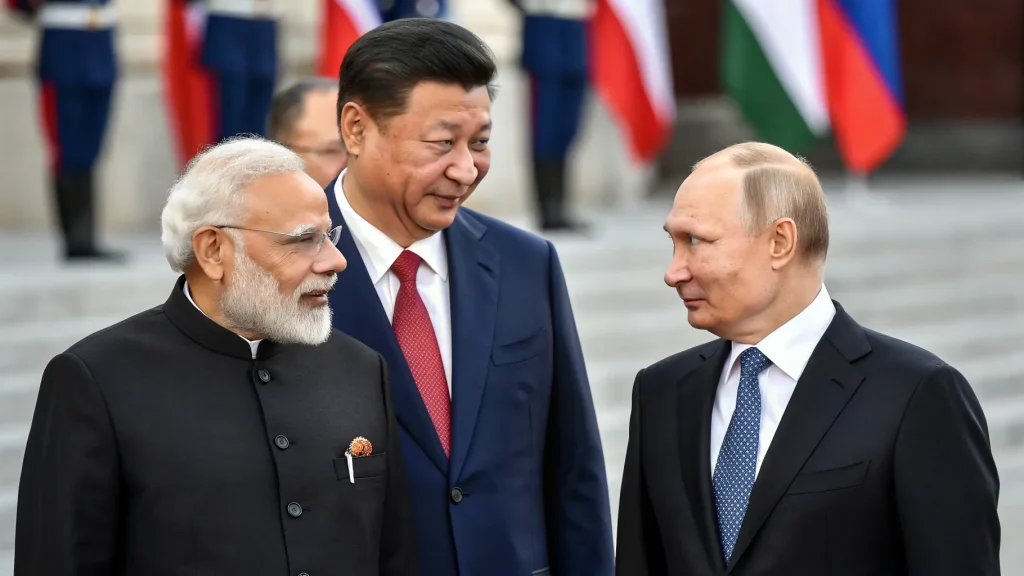
On August 31, the leaders of China, Russia and India met at the Shanghai Cooperation Organisation summit in Bishkek, alongside Iranian President Masoud Pezeshkian.
Think about that configuration.
China.
Russia.
India.
Iran.
Four major players whose interests increasingly intersect with the question of what happens in the Gulf.
None of them needs to want the same outcome.
They simply need to share an interest in reducing American control over the strategic environment.
India has its own problem
India cannot afford to treat Hormuz as somebody else's war.
Its economic links with the Gulf, energy requirements and ambitions for connectivity between India, the Middle East and Europe make stability in the region strategically important.
That gives New Delhi a difficult balancing act.
India needs American security cooperation.
It needs Gulf stability.
It needs access to energy.
And it increasingly wants strategic autonomy.
The more prolonged the Hormuz crisis becomes, the harder those objectives become to reconcile.
Pakistan suddenly matters more
Then there is Pakistan.
Pakistan's geography places it close to the Gulf while giving it relationships with both China and the wider Muslim world.
That makes Islamabad potentially useful as a diplomatic bridge at precisely the moment when traditional channels are under strain.
Pakistan does not need to become a great power to become strategically important.
Sometimes geography does the work.
The real battle is bigger than oil
This is the part many headlines miss.
Hormuz is becoming a test of the entire global system.
Energy.
Shipping.
Insurance.
Food.
Inflation.
Trade.
Diplomacy.
Military power.
And eventually, politics.
A tanker does not have to be sunk for the system to feel the consequences.
If shipping becomes sufficiently risky, companies change routes. Insurance premiums rise. Energy becomes more expensive. Governments intervene. Consumers pay more.
A regional conflict becomes a global economic event.
The American question
For Washington, this creates an uncomfortable strategic paradox.
The United States has overwhelming military capability.
But military superiority does not automatically translate into geopolitical control.
America can destroy launchers.
It can escort ships.
It can impose a blockade.
It can sanction Iran.
But eventually it must answer the political question:
What does victory actually look like?
If the objective is simply to punish Iran, military power may achieve that.
If the objective is to create a stable, open Strait of Hormuz, military power alone may not be enough.
That requires diplomacy.
And diplomacy requires somebody willing to talk.
The Asian century meets the Middle East
This is why Hormuz could redraw Asia.
China is being pulled deeper into the security consequences of Middle Eastern instability.
India is exposed through energy and connectivity.
Pakistan has diplomatic and geographic relevance.
Russia has an interest in weakening Western strategic dominance.
Iran is using geography as leverage.
And the United States is trying to demonstrate that it can still control the global commons.
This is no longer simply America versus Iran.
It is a contest over who gets to shape the rules of a changing international system.
Verifyr's assessment
The most important question is not whether Hormuz reopens tomorrow.
It is what happens after it reopens.
Will Asian powers diversify their energy routes?
Will China accelerate alternative supply chains?
Will India push harder for alternative corridors?
Will Gulf states reconsider their dependence on American security?
Will shipping companies permanently price geopolitical risk into their operations?
And will Washington discover that maintaining control of global chokepoints requires something more complicated than military superiority?
Hormuz may eventually reopen.
But the strategic consequences of its closure may remain.
Because once countries discover how vulnerable their supply chains are, they rarely return completely to the old system.
The Strait of Hormuz is therefore not just a gateway between the Gulf and the Indian Ocean.
**It is becoming a gateway into the next geopolitical order.**
Related intelligence
Kimberly Guilfoyle: When Diplomacy Meets Geopolitical Rivalry
Kimberly Guilfoyle: When Diplomacy Meets Geopolitical Rivalry
13 Oct 2026
Brazil: The Global Power That Refuses to Choose a Side
Brazil: The Global Power That Refuses to Choose a Side
5 Oct 2026
Greenland, Russia, Britain and the Red Sea Signal a New Geopolitical Era
Greenland, Russia, Britain and the Red Sea Signal a New Geopolitical Era
18 Sept 2026
Plans
Free
$0
Instant verdicts, no signup
Pro
$49
Full reports + certificates
Growth
$149
1,000 audits + team access
Newsroom report
$199
One analyst-reviewed certificate
Newsletter
Get verified stories in your inbox
One email when a new audit drops. No spam.