
Audited Story
Washington’s Sahel Dilemma: $147 Million in Health Aid, Then a Human-Rights Warning
By Alain Nzeyimana ·
Washington’s Sahel Dilemma: $147 Million in Health Aid, Then a Human-Rights Warning
Washington’s Sahel Dilemma: $147 Million in Health Aid, Then a Human-Rights Warning
Get our raw articles before they are published anywhere else. Join the official Verifyr Telegram Channel t.me/VerifyrOfficiaVERIFYR FORENSIC AUDIT | VFR-20260815-2WOES6
A striking story is circulating about the changing relationship between the United States and Burkina Faso.
The headline is simple:
Washington is pressuring Burkina Faso over alleged human-rights abuses — just months after agreeing to provide up to $147 million in health assistance.
Verifyr put the underlying story through its forensic audit.
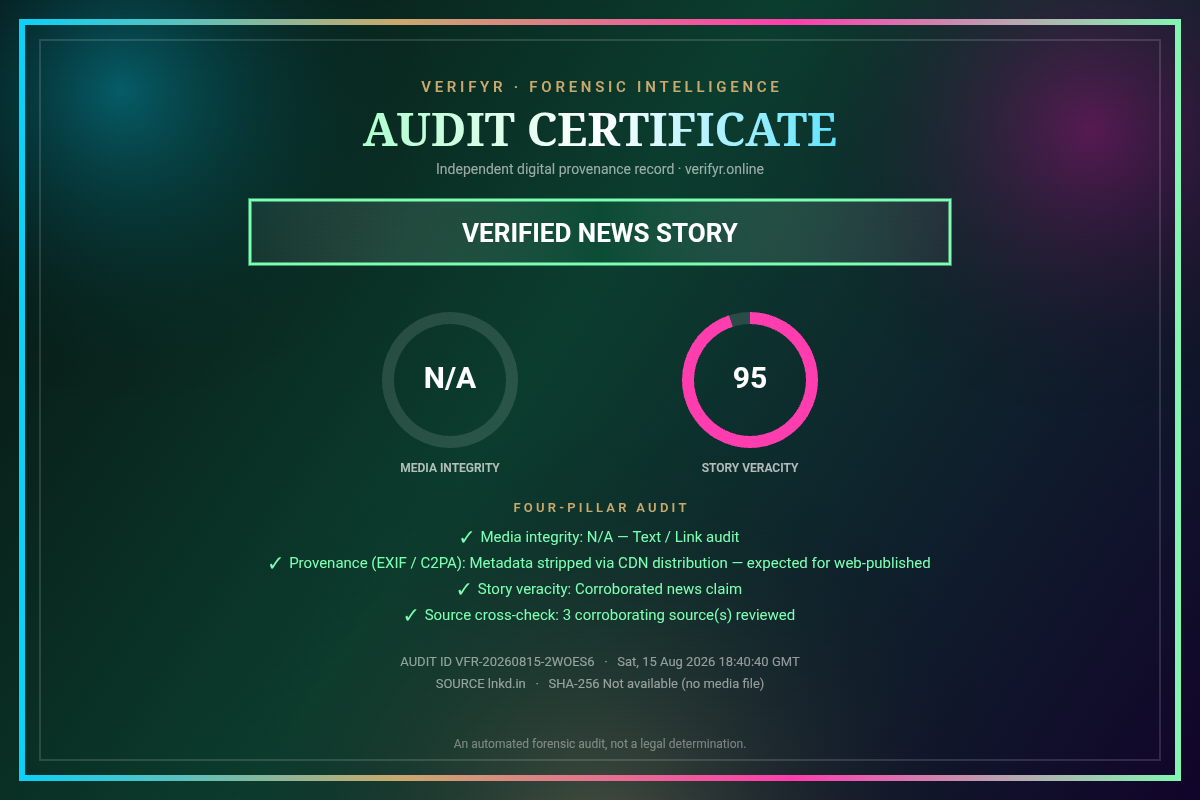
VERDICT: VERIFIED NEWS STORY
Story Veracity: 95/100
The audit found three corroborating sources.
Because the submitted material was a text/link rather than an image or video file, Media Integrity was recorded as N/A. This was a claim-verification exercise, not a synthetic-media examination.
And the evidence is compelling.
From health partnership to human-rights pressure
On February 25, the United States and Burkina Faso signed a five-year health cooperation agreement under the Trump administration's America First Global Health Strategy.
Washington said it intended to provide up to $147 million over five years to support Burkina Faso's fight against HIV/AIDS, malaria and other infectious diseases, as well as disease surveillance and outbreak response. Burkina Faso committed an additional $107 million in domestic health spending.
Six months later, the tone has changed.
On August 12, U.S. Congressman James P. McGovern wrote to Secretary of State Marco Rubio calling for human rights and civilian protection to be placed at the centre of U.S. engagement with Burkina Faso, Mali and Niger.
His intervention included a call for targeted sanctions under the Global Magnitsky Act against individuals implicated in human-rights violations.
That is a significant development.
The contradiction is only apparent
At first glance, Washington's position looks contradictory:
Aid one moment. Sanctions pressure the next.
But the two policies can coexist.
The health agreement is designed around public-health cooperation and U.S. strategic interests in disease prevention.
McGovern's intervention is focused on alleged abuses by security forces and other actors in the Central Sahel.
In other words, Washington can simultaneously say:
“We want to help Burkina Faso's people.”
and
“We are concerned about how power is being exercised.”
The tension lies in how those two objectives are managed.
Why Burkina Faso matters
This is bigger than one bilateral agreement.
Burkina Faso, Mali and Niger have increasingly moved away from traditional Western security partnerships and have created the Alliance of Sahel States (AES).
The three military-led governments have also sought deeper relationships with Russia and other non-Western partners.
For Washington, that creates a difficult strategic equation.
The United States wants influence in a region where jihadist violence remains severe, but its leverage is constrained by deteriorating relations with governments that increasingly reject Western political and security models.
McGovern's intervention therefore lands at a particularly sensitive moment.
The Global Magnitsky question
The reference to the Global Magnitsky Act is especially important.
The legislation gives the U.S. government authority to impose economic sanctions and deny entry to foreign individuals identified as responsible for serious human-rights abuses or corruption.
McGovern isn't announcing sanctions.
He is calling on the administration to consider targeted sanctions.
That distinction matters.
The Verifyr audit therefore supports the story that the congressional pressure exists. It does not mean sanctions have already been imposed.
The bigger geopolitical picture
The Sahel is becoming one of the clearest arenas of competition between Western powers and emerging alternative partnerships.
The United States has lost some of its previous security leverage in the region.
Russia has expanded its political and security relationships.
China remains an important economic actor.
And the AES governments are increasingly presenting sovereignty and strategic autonomy as alternatives to Western conditionality.
Washington therefore faces a difficult choice.
Push harder on human rights and risk further alienating governments that are already distancing themselves from the West?
Or maintain engagement and potentially compromise on issues of accountability?
There is no easy answer.
What the Verifyr audit establishes
The important point is that the viral framing should not obscure the evidence.
The $147 million health agreement is real.
The August 12 intervention by McGovern is real.
The call for consideration of Global Magnitsky sanctions is real.
And the broader deterioration in relations between Washington and the Central Sahel is real.
That is why Verifyr assigned the story a 95/100 Story Veracity score.
Not 100.
Because verification is not about pretending every element of a complex geopolitical story is absolute.
It is about establishing what the evidence can actually support.
VERIFYR VERDICT
Status: Verified News Story Story Veracity: 95/100 Media Integrity: N/A — text/link audit Source: LinkedIn Corroborating sources reviewed: 3 Audit ID: VFR-20260815-2WOES6
The story passes the verification test.
But its real significance goes beyond the headline.
Washington is trying to keep a foothold in a Sahel that is becoming increasingly difficult to influence — while simultaneously confronting governments it believes are failing on human rights.
The $147 million health deal shows that the door to engagement remains open.
McGovern's intervention shows how quickly that engagement can become politically complicated.
In the Sahel, aid, security, sovereignty and human rights are no longer separate conversations. They are the same geopolitical battlefield.
*Verify the evidence. Understand the story.*
Related intelligence
Trump’s Crypto Bank: When Political Power Meets Financial Infrastructure
Trump’s Crypto Bank: When Political Power Meets Financial Infrastructure
17 Aug 2026
When Even the BBC Needs to Be Verified
When Even the BBC Needs to Be Verified
17 Aug 2026
Amorim Gets the Bragging Rights as United’s Pre-Season Ends in Defeat
Amorim Gets the Bragging Rights as United’s Pre-Season Ends in Defeat
15 Aug 2026
Plans
Free
$0
Instant verdicts, no signup
Pro
$49
Full reports + certificates
Growth
$149
1,000 audits + team access
Newsroom report
$199
One analyst-reviewed certificate
Newsletter
Get verified stories in your inbox
One email when a new audit drops. No spam.