
Audited Story
When Even the BBC Needs to Be Verified
By Alain Nzeyimana ·
When Even the BBC Needs to Be Verified
When Even the BBC Needs to Be Verified
Get our raw articles before they are published anywhere else. Join the official Verifyr Telegram Channel t.me/VerifyrOfficiaIn the modern information environment, verification cannot stop at the reputation of the publisher.
That is not an accusation against the BBC. It is the opposite: a recognition that trustworthy journalism and independent verification serve different functions.
A BBC report can be professionally produced, carefully sourced and published in good faith. But once a specific factual claim enters the information ecosystem, it should still be possible to examine the underlying evidence independently.
That is precisely what Verifyr has done with the story submitted for forensic review.
The result was not a conventional “true” or “false” verdict.
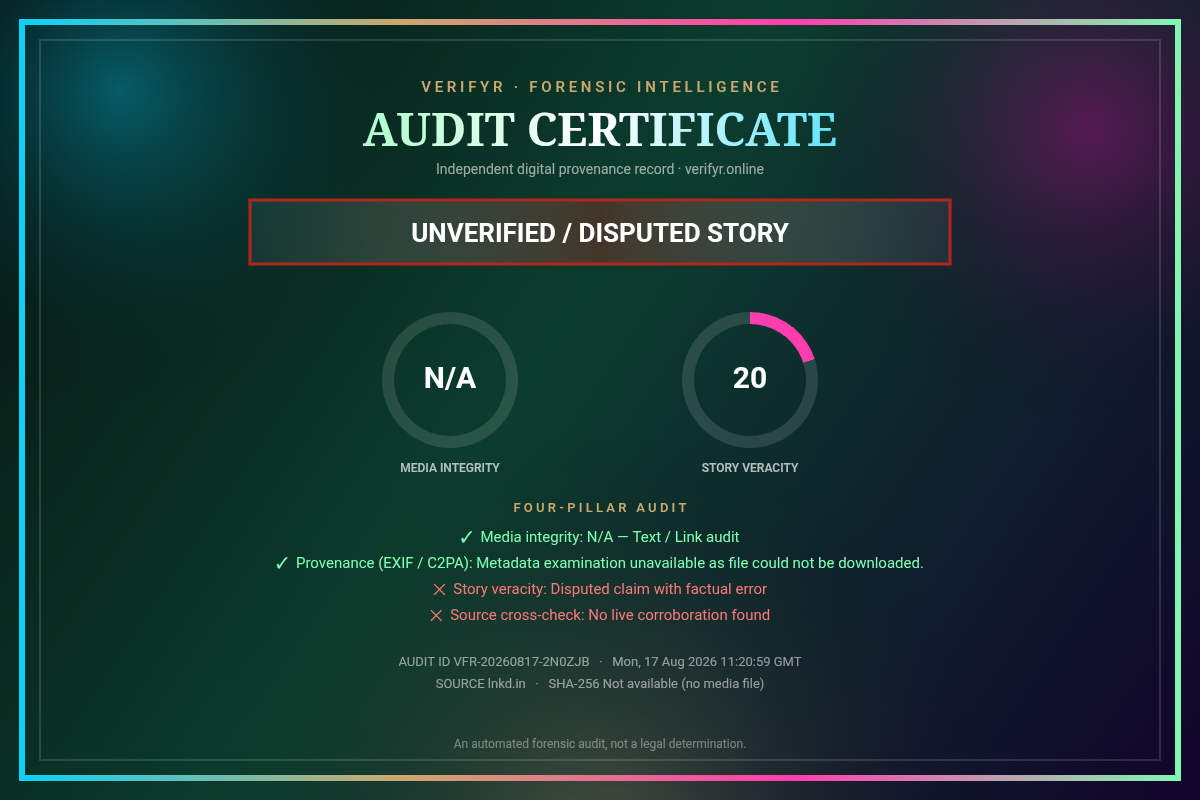
It was UNVERIFIED / DISPUTED STORY.
The Verifyr audit assigned the claim a 20/100 story-veracity score. The audit also found no live corroboration supporting the disputed claim and identified a factual error requiring further examination.
Importantly, the audit did not establish that the BBC itself fabricated the story.
That distinction matters.
Source credibility is not evidence credibility
There is an increasingly common assumption in the digital information environment:
If a major news organisation published something, the claim itself has effectively been verified.
That is understandable—but analytically dangerous.
A publisher's reputation tells us something about the source.
It does not automatically settle the claim.
Verification asks different questions:
What exactly is being claimed?
What evidence supports it?
Can the evidence be independently corroborated?
Are the underlying facts consistent?
Is the claim being reported as established fact when the available evidence remains contested?
Has new information emerged that changes the evidentiary picture?
These questions remain legitimate regardless of whether the original source is the BBC, Reuters, a government department, a major newspaper—or an anonymous social-media account.
This is where independent verification matters
The purpose of Verifyr is not to create another hierarchy of media organisations.
It is to introduce another layer of scrutiny between publication and acceptance.
That distinction becomes increasingly important as information moves at extraordinary speed.
A claim can be published by a credible organisation, repeated across social platforms, incorporated into commentary and eventually become accepted as “what happened” before anyone stops to examine whether the original proposition has actually been independently established.
By then, correcting the record becomes much harder.
The Verifyr approach therefore treats verification as a process rather than a badge of institutional authority.
In this case, the conclusion was deliberately cautious:
Unverified / disputed.
Not “the BBC is fake.”
Not “the story is fabricated.”
Not “believe Verifyr instead.”
Simply: the available evidence did not justify treating the disputed claim as established fact.
The uncomfortable question
This raises a bigger issue for journalism, intelligence and AI.
What happens when a highly credible source publishes something that cannot subsequently be independently corroborated?
The answer should not be automatic acceptance—or automatic rejection.
It should be investigation.
That is particularly important in an era when AI systems can ingest published material, reproduce it, summarise it and generate new analysis from it within seconds.
If the original claim is wrong, every subsequent layer can become contaminated.
A single unsupported assertion can therefore become dozens of apparently independent references to the same assertion.
Repetition can create the appearance of corroboration without actually providing corroboration.
That is one of the central problems of the information age.
Verification must remain source-neutral
The real test of a verification system is not whether it challenges obscure websites.
Anybody can do that.
The harder test is whether the same methodology is applied when the source is prestigious.
That is the standard Verifyr is attempting to establish.
The question is not: “Who published it?”
The question is:
“What can the evidence actually support?”
That is a much higher bar.
And it should apply to everyone.
By Alain Nzeyimana Founder & CEO | Verifyr
Related intelligence
Trump’s Crypto Bank: When Political Power Meets Financial Infrastructure
Trump’s Crypto Bank: When Political Power Meets Financial Infrastructure
17 Aug 2026
Washington’s Sahel Dilemma: $147 Million in Health Aid, Then a Human-Rights Warning
Washington’s Sahel Dilemma: $147 Million in Health Aid, Then a Human-Rights Warning
15 Aug 2026
Amorim Gets the Bragging Rights as United’s Pre-Season Ends in Defeat
Amorim Gets the Bragging Rights as United’s Pre-Season Ends in Defeat
15 Aug 2026
Plans
Free
$0
Instant verdicts, no signup
Pro
$49
Full reports + certificates
Growth
$149
1,000 audits + team access
Newsroom report
$199
One analyst-reviewed certificate
Newsletter
Get verified stories in your inbox
One email when a new audit drops. No spam.